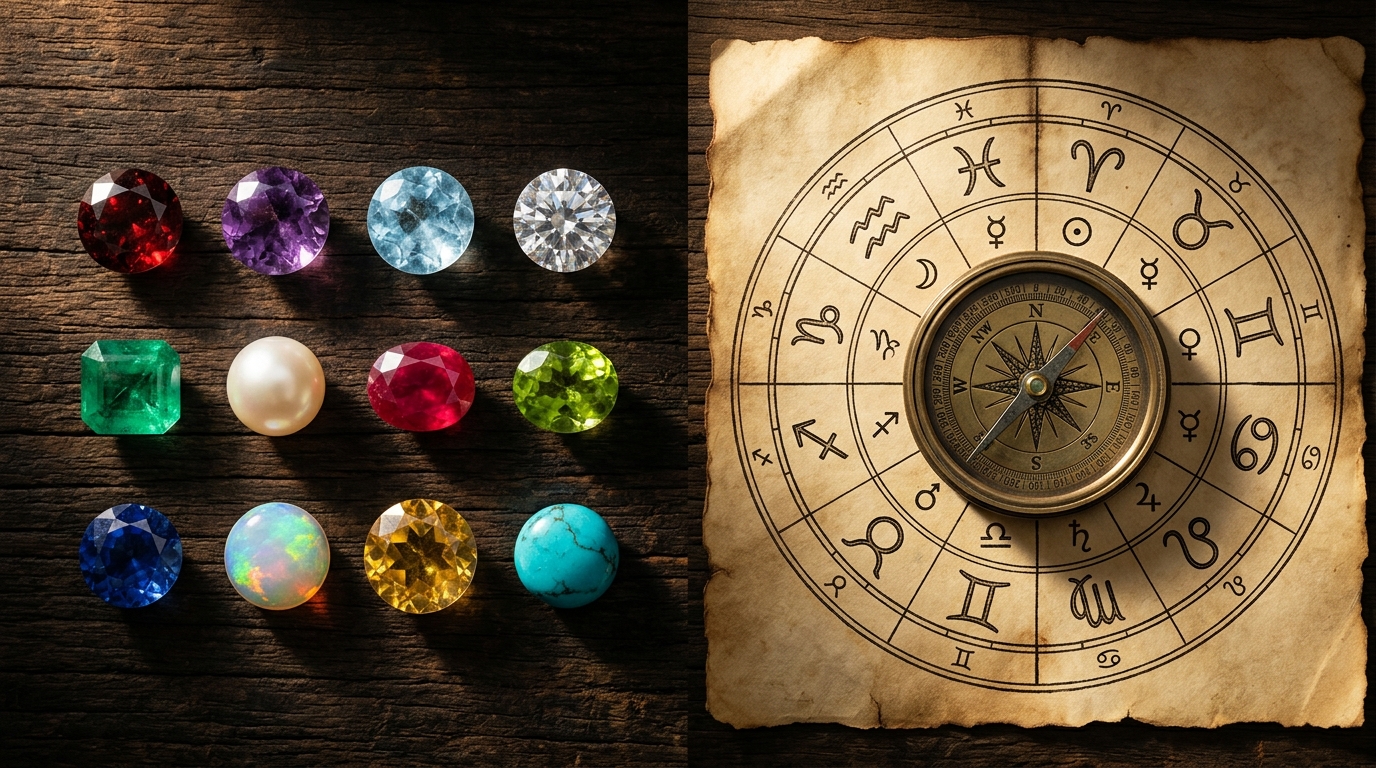
The one-line difference
Here's the mix-up, cleared up in one sentence: a birthstone chart matches a gemstone to your birth month, while a birth chart maps where the planets sat in the sky at the exact moment you were born. That's it. One is jewelry tradition, the other is astrology. They landed on the same two words by accident, not by design, and the internet has been quietly conflating them ever since.
If you searched "birthstone chart" wanting to know whether your ring should have a garnet or an amethyst in it, the next section has your answer, fast and factual. But if what actually brought you here was something closer to "what does my birth chart say about me," you're looking for a completely different tool — one built from your birth date, time, and location rather than just the month on your driver's license.
Both are real, useful, and worth knowing about. Neither one is a substitute for the other, and no jewelry chart is going to tell you why you keep dating the same person in different bodies, and no astrological chart is going to tell you what stone looks good on your hand. Read on for the quick version of both, so you can figure out which one you actually came here for — and get pointed toward the right kind of chart entirely.
Where birthstones come from
A birthstone is a gemstone tied to the month you were born, a tradition with roots stretching back centuries and formalized into the list most jewelers use today. Wikipedia describes it plainly: a birthstone represents a person's birth month. The list you'll see in most stores traces back to an official standardization; Jewelers.org notes that the official U.S. birthstone list dates back to 1912, which is why you'll sometimes see both a "traditional" and a "modern" stone listed for the same month — the newer list didn't fully replace the older folklore, it just got layered on top.
Here's the current month-by-month rundown, based on the American Gem Society's chart:
- January – Garnet
- February – Amethyst
- March – Aquamarine or Bloodstone
- April – Diamond
- May – Emerald
- June – Pearl, Moonstone, or Alexandrite
- July – Ruby
- August – Peridot or Spinel
- September – Sapphire
- October – Opal or Tourmaline
- November – Topaz or Citrine
- December – Tanzanite, Turquoise, or Zircon
Some months only have one widely recognized stone; others carry two because tradition and modern gemology never fully agreed. Worth knowing: there's also a folk practice assigning stones by day of the week rather than month, tied to old planetary associations — a gem forum discussion shows people still trading theories on which stone matches which day's "energy," though that's a separate, much less standardized tradition than the monthly list above.
What a birth chart actually is
A birth chart, by contrast, has nothing to do with gemstones. In general astrological terms — not a personal reading, just how the concept works — a birth chart is a map of the sky at the moment you were born. It records where the sun, moon, and planets were positioned against the backdrop of the zodiac, from the vantage point of your exact birth location, at your exact birth time.
That map is not a prediction and not a fixed script for your life. It's closer to a floor plan: it shows you the rooms — where your sun sign sits, where your moon and rising sign fall, how the planets relate to each other — and you're the one who walks through them and decides what to do with the layout. Two people born on the same day in different cities, or at different hours, can end up with meaningfully different charts, because the sky keeps moving all day long.
This is the concept people usually mean when they type "birth chart" into a search bar hoping to understand a pattern in their life — a relationship that keeps repeating, a career that feels stuck, a personality trait they can't quite explain. None of that comes from a birthstone. It comes from the placements in an actual birth chart, interpreted by someone (or something) that knows how to read one. If that's closer to what you were actually curious about, the birthstone list above isn't going to get you there — the rest of this post will.
If you meant the astrology kind, start here
If you read the last section and thought "yes, that one" — welcome, you're in the right place now. A birth chart is genuinely worth generating properly, with your accurate birth time and location, rather than guessing. You can see what a real birth chart actually shows once it's calculated from your specific details, which is the only way the map is actually useful instead of generic.
From there, a few places worth going next, depending on what pulled you in tonight. If you're wondering how your chart changes over time rather than staying fixed forever, Your Birth Chart Is a Snapshot — Transits Are the Weather explains the difference between the chart itself and the planetary "weather" moving over it. If you're curious whether an AI tool can actually read your chart or is just guessing convincingly, Can ChatGPT Read Your Birth Chart? It Can Fake It Convincingly — That's the Problem is worth a look before you trust a chatbot with your placements. And if the "why do I keep repeating this" feeling is what brought you here in the first place, Chiron in the Birth Chart: The Placement That Explains the Pattern You Keep Repeating goes straight at that.
None of it requires knowing a single thing about gemstones. Different word, different sky, different answer — and now you know which one you were actually after.